
Inside the lightning US strike that overwhelmed Venezuela’s defenses and seized Maduro
The U.S. military launched strikes against Venezuela and captured its dictator, Nicolás Maduro, on Jan. 3 — emerging from the operation largely unscathed as it handicapped Venezuela’s defense systems and potentially conducted cyber operations against Caracas.
Altogether, more than 150 aircraft — including U.S. bombers and fighter jets — were involved in the operation, successfully completing a ‘large-scale strike’ against Venezuela, according to President Donald Trump. Additionally, Caracas, Venezuela, suffered power outages early Jan. 3 — an indication of a potential cyber operation.
Trump signaled that the U.S. may have been behind the blackout in Venezuela but did not provide details regarding the nature of a possible cyber operation targeting Venezuela’s civilian infrastructure.
‘The lights of Caracas were largely turned off due to a certain expertise that we have,’ Trump said.
Mark Cancian, a senior adviser with the Center for Strategic & International Studies’ defense and security department, said that while it’s unclear what exactly U.S. Cyber Command (CYBERCOM) and Space Command (SPACECOM) contributed to the operation, they may have penetrated some of Venezuela’s infrastructure.
‘We don’t really know what cyber did, some of the lights did go out, and Caine did talk about it,’ Cancian told Fox News Digital Wednesday. ‘It’s possible that (they) got into some of their command and control systems.’
Gen. Dan Caine, chairman of the Joint Chiefs of Staff, said that as U.S. helicopters with the extraction force and other law enforcement assets started to approach Venezuela’s shores, the U.S. ‘began layering different effects provided by SPACECOM, CYBERCOM, and other members of the inter-agency to create a pathway.’
According to Caine, U.S. aircraft involved in the operation included F-22, F-35, F/A-18 and EA-18 fighter jets, E-2 airborne early warning aircraft, B-1 bombers and ‘other support aircraft, as well as numerous remotely piloted drones.’
‘As the force began to approach Caracas, the joint air component began dismantling and disabling the air defense systems in Venezuela, employing weapons to ensure the safe passage of the helicopters into the target area,’ Caine told reporters.
These aircraft involved in the mission also likely employed weapons including the AGM-88 HARM, or high-speed anti-radiation missile, which neutralizes radar-equipped enemy air defense systems and other air-to-ground munitions to take out Venezuela’s air defense systems, according to Cancian.
A spokesperson for SPACECOM said that the command could not comment on the specific details of support SPACECOM provided to Operation Absolute Resolve, due to operational security concerns. But the spokesperson added that space-based capabilities including positioning, navigation and timing (PNT) that the military uses to support electronic warfare, in addition to other things, as well as satellite communications are ‘foundational to all modern military activities.’
‘To protect the Joint Force from space-enabled attack and ensure their freedom of movement, U.S. Space Command possesses the means and willingness to employ combat-credible capabilities that deter and counter our opponents and project power in all warfighting domains,’ the spokesperson said in a statement to Fox News Digital Friday.
CYBERCOM did not immediately respond to a request for comment from Fox News Digital.
Other factors that contributed to the U.S. military’s success undermining Venezuela’s defenses were that CIA assets had been on the ground leading up to the raid, according to Cancian. Trump confirmed in October 2025 that he had authorized the CIA to conduct covert operations in Venezuela.
‘They gave detailed descriptions of Maduro’s headquarters, and I’m sure located all of the air defense batteries around Caracas,’ Cancian said. ‘So we had an excellent sense about where everything was, combining that with overhead surveillance and also electromagnetic intelligence.’
Although Venezuela ‘on paper’ has powerful air defense systems, Cancian said that success pulling off the operation stemmed from solid efforts from the U.S. military to destroy and disrupt Venezuela’s air defense system, in conjunction with poor training for Venezuela’s military.
Venezuela is equipped with Russian S-300 long-range surface-to-air missile systems, as well as Buk-M2E and Pechora-2M medium-range surface-to-air missile systems, according to the Modern War Institute at West Point.
Of the more than 150 U.S. aircraft involved in the operation, only one was hit, and zero were shot down. An administration official told Fox News Digital that seven U.S. service members were injured during the operation, but were ‘well on their way to recovery.’
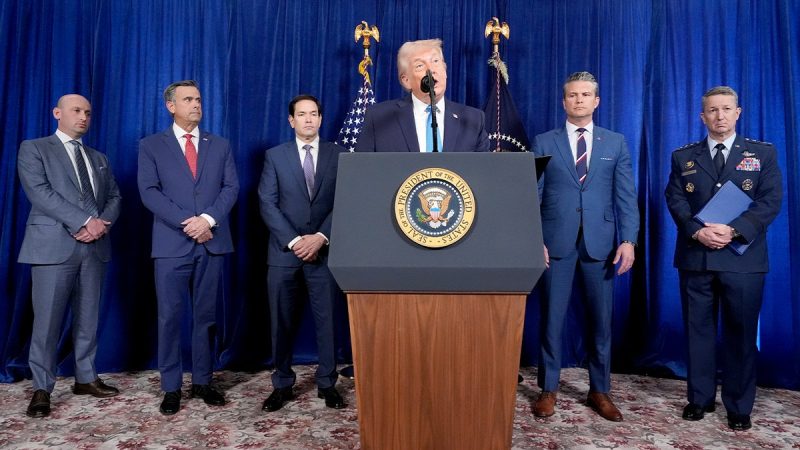
‘Seems those Russian air defenses didn’t quite work so well, did they?’ Secretary of War Pete Hegseth told reporters in Newport News, Virginia.
Trump announced that U.S. special forces conducted a strike against Caracas, Venezuela, and seized Maduro and his wife, Cilia Flores. The two were taken to New York and appeared in a Manhattan federal court Jan. 5 on drug charges. Both pleaded not guilty.
The raid came after months of pressure on Venezuela amid a series of strikes in Latin American waters targeting alleged drug traffickers in alignment with Trump’s effort to crack down on the influx of drugs into the U.S.
The Trump administration repeatedly stated that it did not recognize Maduro as a legitimate head of state and insisted he was the leader of a drug cartel. Trump also said in December he thought it would be ‘smart’ for Maduro to step down.
The Trump administration has since claimed that its actions seizing Maduro were justified as a ‘law enforcement’ operation, and Secretary of State Marco Rubio said congressional approval wasn’t necessary since the operation didn’t amount to an ‘invasion.’
Even so, lawmakers primarily on the left have questioned the legality of the operation in Venezuela, which was conducted without Congress’ approval.
‘This has been a profound constitutional failure,’ the top Democrat on the Senate Armed Services Committee, Sen. Jack Reed, D-R.I., said in a statement Jan. 3. ‘Congress — not the President — has the sole power to authorize war. Pursuing regime change without the consent of the American people is a reckless overreach and an abuse of power.’
‘The question now is not whether Maduro deserved removal. It is what precedent the United States has just set and what comes next.’
Fox News’ Morgan Phillips contributed to this report.